Initial Assessment
Back Panel Opened
Section titled “Back Panel Opened”Removing the rear cover revealed:
- Nameplate confirming Model 555, 117V / 60Hz / 155W / 210 VA. Serial number field present but unstamped.
- Leslie Tremolo Unit manufactured by Electro Music / CBS Musical Instruments (Pasadena, CA) — not a Wurlitzer product. Complete schematic and maintenance instructions on cabinet labels. Part No. 660890, EMI No. 600900.
- Transistor Basing Arrangement chart (Wurlitzer Co. Corinth Div., Label 505983 ISS.5) showing pinouts for all transistor types used in the organ.
- Separate patent license label — “Licensed Under U.S. Patent 3,316,341” (The Wurlitzer Co., Label No. 509573).
- One small doll and a jack-o-lantern bucket lodged between the wiring harness and the cabinet floor — dropped through the keys by a previous owner’s child at some indeterminate point in the last fifty years.
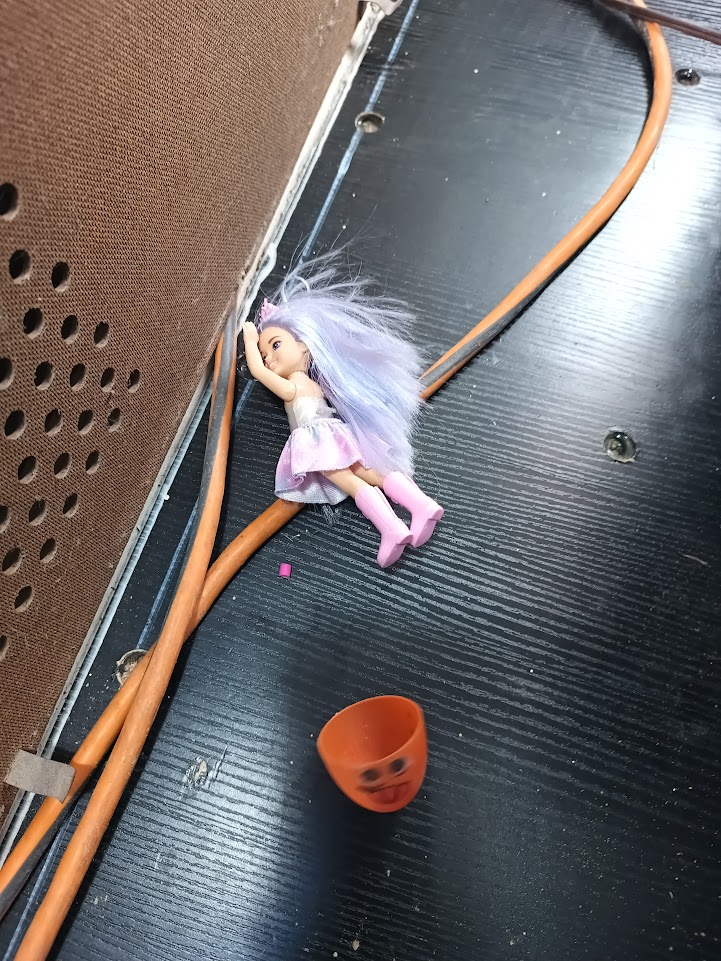 Provenance artifact recovered during back panel removal. Photo: Ryan Malloy.
Initial Power-On (10-minute test)
Section titled “Initial Power-On (10-minute test)”Connected to AC power after transport. Storage duration unknown.
| System | Status | Notes |
|---|---|---|
| Upper Manual (Swell) | Working | All keys responded during brief test |
| Lower Manual (Great) | Mostly working | Rightmost key (C6) sticks mechanically — likely felt/bushing, not electrical |
| Pedalboard | Working | Ping-pong ball extracted from right side of left pedal area before testing |
| Orbit III Synthesizer | Working | Proprietary ICs confirmed alive — plays through all presets tested |
| Orbit III Pots | Dirty/scratchy | All potentiometers on Orbit III panel need cleaning |
| Orbit III Sine Wave Volume | Stuck | LEFT volume knob (Sine Wave section) is physically seized — will not rotate |
| Leslie Speaker | Working | Rotary speaker engages and spins correctly |
| Expression Pedal (volume) | Working | Vertical axis (volume swell) responds |
| Expression Pedal (slide) | Present | Lateral push-left axis — needs further testing with Orbit III |
| Rhythm Section | Not yet tested | |
| Tab Stops (individual) | Not yet tested | |
| Reverb | Not yet tested | |
| Cassette Deck | Not yet tested |
Condition Summary
Section titled “Condition Summary”The organ survived storage remarkably well. Ten continuous minutes of play without audio dropout, hum escalation, or smoke is a good sign for the electrolytic capacitors — but the community-documented “3-week phenomenon” means caps should still be replaced proactively. Unused organs that seem fine initially can develop cap failures after sustained warmup cycles.
Immediate Maintenance Queue
Section titled “Immediate Maintenance Queue”- Clean all Orbit III pots with DeoxIT D5 (fader lube for the stuck one)
- Free or replace the stuck Sine Wave volume pot
- Investigate and fix sticky lower manual C6 key
- Complete testing of rhythm section, individual tab stops, reverb, cassette deck
- Extended burn-in test (30+ minutes) to check for cap-related failures
- Photo-document back panel labels (nameplate, Leslie, transistor basing chart)
- Photo-document circuit boards (top side, with back panel off) — see Console Disassembly
Next Steps
Section titled “Next Steps”- Buy the Orbit III service manual from eBay (~$30-50)
Identify TOS and divider-keyer IC part numbers on the actual boards— done, see IC Identification- Bench probing sessions to characterize signals before MIDI hardware — see Bench Probing Plan
- Recap power supply electrolytics (~$30 in parts)