Known Issues
Community-Reported Problems
Section titled “Community-Reported Problems”1. Electrolytic Capacitor Failure
Section titled “1. Electrolytic Capacitor Failure”The number one cause of hum, fading audio, volume imbalances, and intermittent cutouts. All electrolytics should be replaced proactively — budget about $30 in parts for a complete recap.
2. Key Contact Oxidation
Section titled “2. Key Contact Oxidation”Silver-plated contacts can develop a thin oxide layer from years of storage. Usually resolved by simply playing the keys — the plunger action scrapes the contacts clean. For stubborn cases, a small amount of contact cleaner works. These contacts are generally very durable.
3. Orbit III Proprietary ICs
Section titled “3. Orbit III Proprietary ICs”If the Orbit III’s proprietary Wurlitzer ICs fail, replacement is only possible from donor organs. There are no modern equivalents or aftermarket replacements. This makes the Orbit III boards the most irreplaceable components in the instrument.
4. Divider IC Shorts
Section titled “4. Divider IC Shorts”The 4-legged and 6-legged divide-by-two ICs under the top manual can short to the power rails. This failure mode is dangerous because a shorted divider can blow the Top Octave Synthesizer IC above it — a more expensive and harder-to-replace component.
Always check resistance before replacing: From any divider point to ground with no key down, expect about 2.5K ohms to ground or B+.
5. Scratchy Pots and Switches
Section titled “5. Scratchy Pots and Switches”Age-related oxidation on potentiometer wipers and switch contacts. Cleanable with DeoxIT D5 contact cleaner (or DeoxIT FaderLube for pots that need lubrication). This is a maintenance item, not a failure.
6. Connector Issues
Section titled “6. Connector Issues”Despite Wurlitzer’s high-quality house-made connectors (not standard AMP/Molex), decades of thermal cycling can loosen connections. Reseating all internal connectors during a service session can resolve intermittent problems that appear unrelated.
7. Pinched Wire from Keyboard Tilt
Section titled “7. Pinched Wire from Keyboard Tilt”During console disassembly, a wire harness was caught between the keyboard hinge point and the chassis when tilting the upper manual forward. The insulation may be nicked — needs closer inspection with the organ unplugged before next power-on.
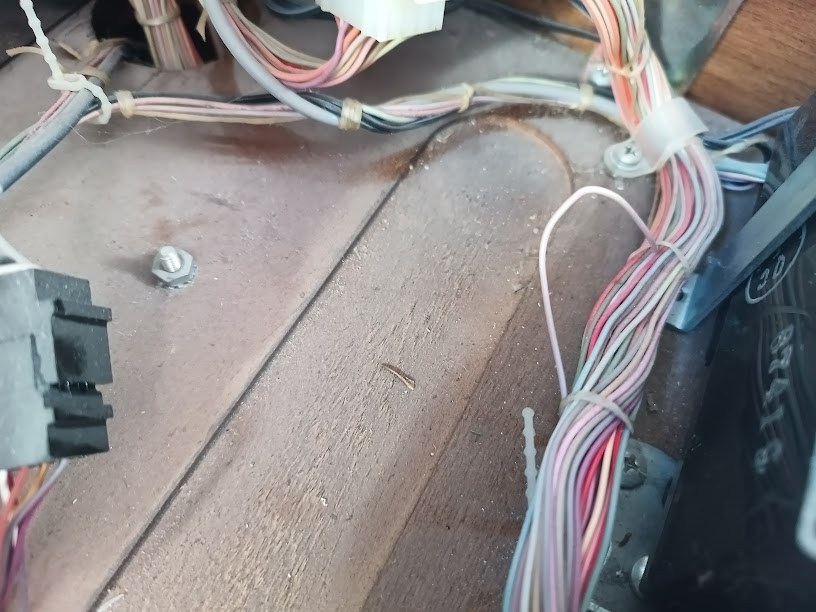 Wire harness caught during keyboard tilt. Check for exposed copper or nicked insulation before powering on. Photo: Ryan Malloy.
Status: Open — needs inspection under magnification with the organ unplugged. If the insulation is compromised, the wire should be sleeved with heat-shrink tubing before reassembly. A short at this location could affect the upper manual keying circuits.