Leslie Motor Simulations
The Motor
Section titled “The Motor”The Leslie Tremolo Unit (CBS/Electro Music, Part 660890) uses an 18W shaded-pole AC induction motor. It is a 20-pole design with a synchronous speed of 360 RPM at 60 Hz. Both simulations share the same electrical model: a series R-L circuit with R = 300 ohm winding resistance and L = 1H motor inductance. At 60 Hz this gives an impedance of about 482 ohm, a power factor of 0.62, and a rated current of 0.24A — yielding the 17.6W nameplate power.
The 1H inductance is the dominant characteristic. It causes current to lag voltage by about 52 degrees at 60 Hz and, as we will see, makes the motor an effective low-pass filter for high-frequency switching signals.
See Leslie Control for the physical unit, schematic labels, and wiring details.
TRIAC Phase-Angle Control (Existing Circuit)
Section titled “TRIAC Phase-Angle Control (Existing Circuit)”The stock Leslie speed controller fires a TRIAC at different phase angles each half-cycle of the 60 Hz mains. Earlier firing delivers more of the sine wave to the motor (more voltage, more power); later firing chops the waveform aggressively, reducing RMS voltage and torque. A reed switch selects between two fixed firing angles — FAST and SLOW — actuated by a coil driven from the console’s three-position switch.
Results
Section titled “Results”| Setting | Firing Angle | Motor RMS Voltage | % of Line | Power | Speed |
|---|---|---|---|---|---|
| FAST | 25 deg | 116.1V | 99.2% | ~17.3W | ~340 RPM |
| SLOW | 110 deg | 62.7V | 53.6% | ~5.1W | ~40 RPM |
Motor Terminal Voltage
Section titled “Motor Terminal Voltage”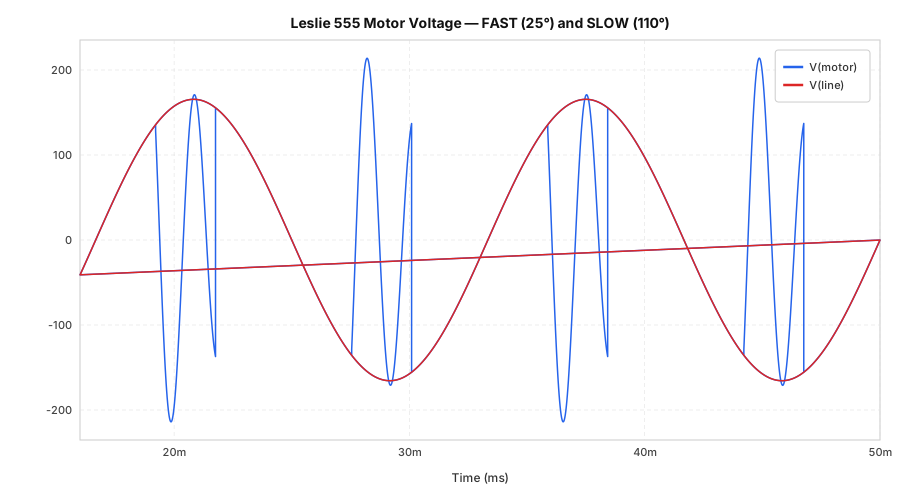 Motor terminal voltage, FAST and SLOW overlaid. FAST is nearly a full sine wave; SLOW shows severe chopping with conduction only in the last ~70 degrees of each half-cycle.
Motor Winding Current
Section titled “Motor Winding Current”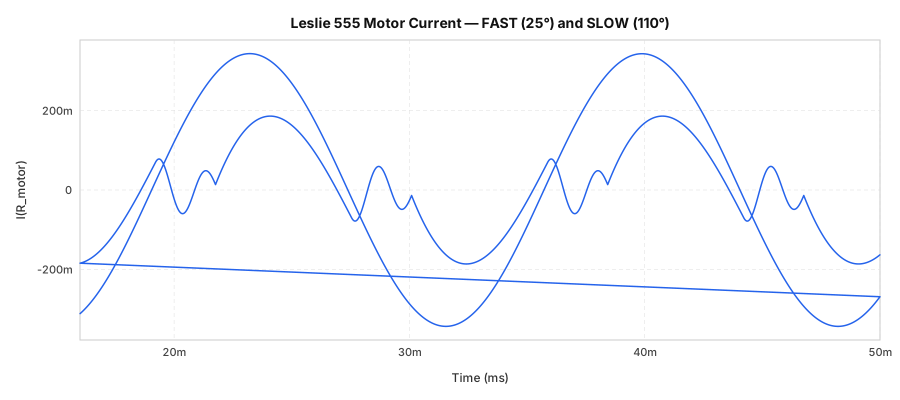 Motor winding current for both speeds. Current lags voltage — the inductive load continues drawing current past the voltage zero crossing. The simulation models this by extending the TRIAC conduction window 55 degrees past zero to account for the power factor lag (real TRIACs conduct until current, not voltage, crosses zero).
Circuit Notes
Section titled “Circuit Notes”The simulation includes a 100 ohm + 100 nF R-C snubber across the TRIAC, standard practice for inductive loads to damp the voltage spike at commutation. The power factor lag modeling is important: without it, the current waveform would show an unrealistic sharp cutoff at the voltage zero crossing.
The key observation is that the motor’s synchronous speed stays at 360 RPM regardless of TRIAC firing angle — speed reduction comes entirely from high slip and torque loss. At SLOW, the motor is operating deep in its unstable torque-speed region, fighting its own rotating magnetic field. This works, but it is thermally inefficient and gives no possibility of intermediate speeds.
ESP32 MCPWM Micro-VFD (Proposed)
Section titled “ESP32 MCPWM Micro-VFD (Proposed)”The alternative approach discards phase-angle chopping entirely. Instead: rectify the 117 VAC mains to a 165V DC bus, then use the ESP32-S3’s MCPWM peripheral to generate sinusoidal pulse-width modulation (SPWM) through a full H-bridge at variable frequency. Constant V/Hz scaling — modulation index m = f_motor / 60 — maintains motor flux across the entire speed range.
Results
Section titled “Results”| Frequency | Mod Index | V_fund (RMS) | Motor Z | Current | Power | Sync Speed |
|---|---|---|---|---|---|---|
| 10 Hz | 0.167 | 19.4V | 306 ohm | 63 mA | 1.2W | 60 RPM |
| 20 Hz | 0.333 | 38.9V | 325 ohm | 120 mA | 4.3W | 120 RPM |
| 40 Hz | 0.667 | 77.8V | 391 ohm | 199 mA | 11.8W | 240 RPM |
| 60 Hz | 1.000 | 116.7V | 482 ohm | 242 mA | 17.6W | 360 RPM |
Motor Winding Current (All Frequencies)
Section titled “Motor Winding Current (All Frequencies)”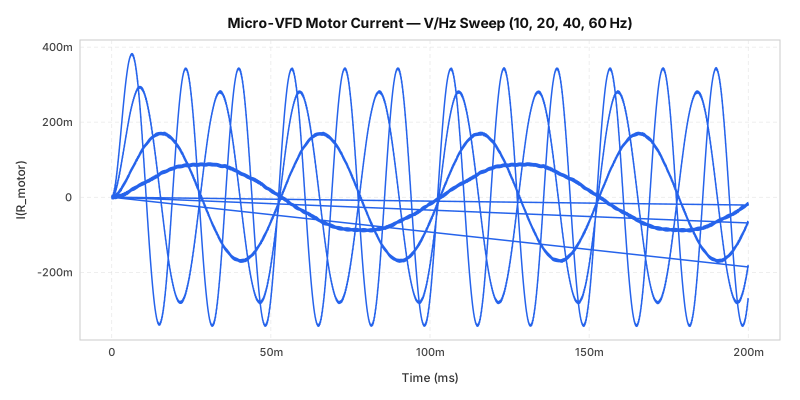 Motor winding current at all four frequencies overlaid. Each is a clean sinusoid — the motor inductance completely filters the 10 kHz switching. Current scales linearly with V/Hz, from 63 mA at 10 Hz to 242 mA at rated 60 Hz.
H-Bridge SPWM Output
Section titled “H-Bridge SPWM Output”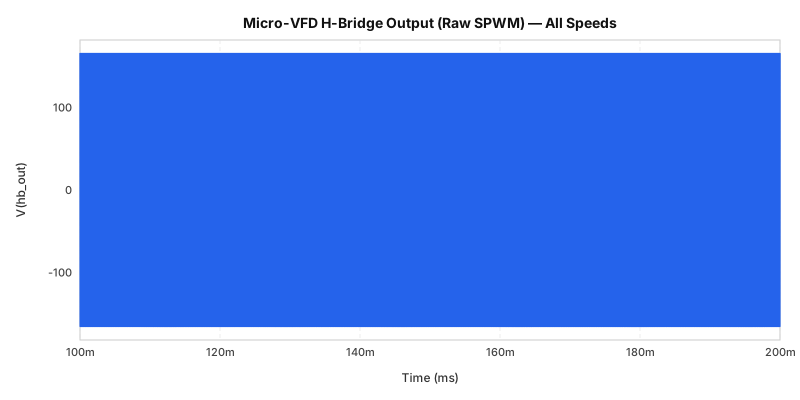 Raw H-bridge SPWM output (100-200 ms window). The output swings between +165V and -165V with duty cycle modulated by the sine reference. This is what the motor terminals see before the winding inductance filters it.
Voltage vs. Current at 60 Hz
Section titled “Voltage vs. Current at 60 Hz”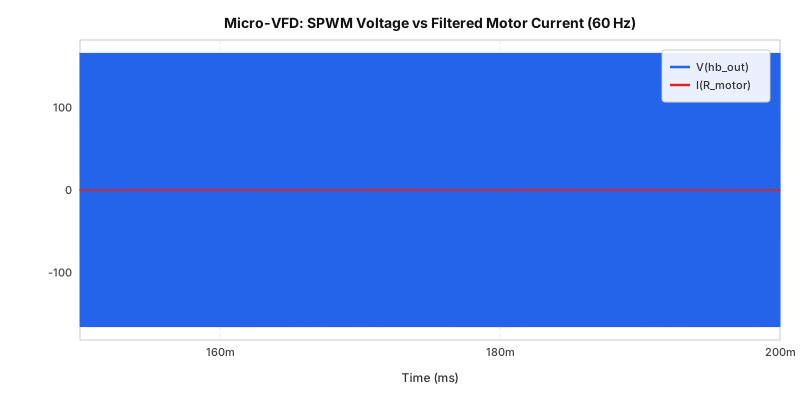 SPWM voltage and motor current overlaid at 60 Hz (150-200 ms). The raw PWM voltage (sharp bipolar switching) produces a smooth sinusoidal current through the motor — a direct demonstration of the motor-as-filter principle.
Comparison
Section titled “Comparison”| TRIAC (Existing) | VFD (Proposed) | |
|---|---|---|
| Speed control | 2 fixed speeds (FAST / SLOW) | Continuous, 60-360 RPM |
| Speed method | Voltage reduction at fixed 60 Hz | Frequency + voltage reduction (V/Hz) |
| Motor behavior at low speed | High slip, fights sync speed | Optimal slip at every speed |
| Interface to ESP32 | Relay or optocoupler across reed coil | MCPWM direct to H-bridge |
| MIDI mapping | CC#80 three-state (off/slow/fast) | CC#1 continuous + CC#80 presets |
| Ramp profiles | Mechanical inertia only | Programmable in firmware |
| Additional BOM | ~$2 (relay + driver) | ~$10 (rectifier, caps, MOSFETs, gate driver) |
| Mains isolation | Inherent (relay/opto) | Requires design attention |
Both approaches are viable. Scenario A (relay drive of the existing TRIAC circuit) is the baseline — proven, simple, zero risk to the motor. The VFD is the stretch goal: it unlocks continuous speed and firmware-shaped ramp curves, making CC#1 mod-wheel Leslie control musically meaningful.
VFD Candidate BOM
Section titled “VFD Candidate BOM”| Component | Value | Purpose |
|---|---|---|
| Bridge rectifier | 4x 1N4007 | Mains rectification to 165V DC |
| Bulk capacitor | 220 uF / 200V | DC bus smoothing |
| MOSFETs | 4x IRF840 (or IRFP460) | H-bridge power stage |
| Gate driver | IR2110 or IR2184 | High/low-side MOSFET drive with bootstrap |
| ESP32-S3 | MCPWM peripheral | SPWM generation, V/Hz control |
| Bootstrap caps | 2x 10 uF / 25V | Gate driver bootstrap supply |
Total power-stage BOM is under $10. The ESP32 is already part of the MIDI conversion design — the MCPWM peripheral is a hardware feature that costs nothing extra.
Source Files
Section titled “Source Files”The SPICE netlists are in the project repository:
leslie-triac-motor-control.cir— TRIAC phase-angle simulation,.step param alpha list 25 110leslie-vfd-motor-control.cir— ESP32 MCPWM VFD simulation,.step param f_motor list 10 20 40 60
Both run via LTspice under Wine on Linux. See the sims/ README for instructions.
Cross-References
Section titled “Cross-References”- Leslie Control — physical unit identification, schematic, TRIAC circuit details, and MIDI interface options
- Simulations — CapSense detection chain simulations (separate subsystem)
- Approach — overall MIDI conversion architecture
- Implementation Roadmap — build sequence and phase plan