Specifications
The Wurlitzer Custom Funmaker Model 555 is a dual-manual analog home organ manufactured circa 1974 by the Wurlitzer Company at their De Kalb Division in De Kalb, Illinois.
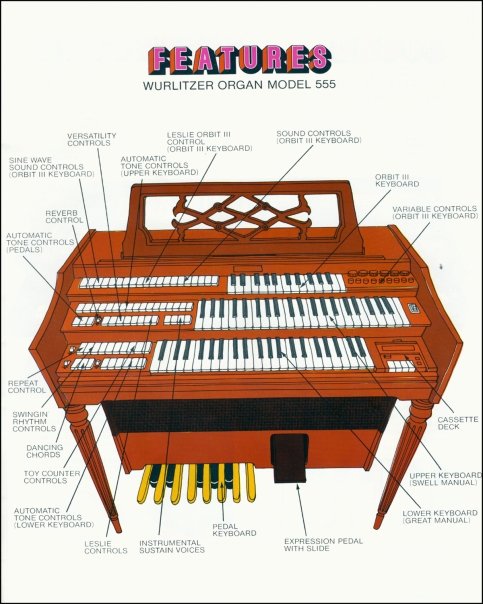 Console layout from the 1973 owner’s manual. Image: The Wurlitzer Company.
Specifications
Section titled “Specifications”| Spec | Detail |
|---|---|
| Model | Wurlitzer Custom Funmaker 555 |
| Serial No. | Blank (stamping field present but unstamped — known to occur on some production runs) |
| Year | ~1974 (copyright date on manual: 1973) |
| Manufacturer | The Wurlitzer Company, De Kalb Division, De Kalb, IL 60115 |
| Manual Part No. | 560609 / Form F 3407 |
| Upper Manual (Swell) | 44 keys, silver-plated contacts |
| Lower Manual (Great) | 44 keys, silver-plated contacts |
| Orbit III Synthesizer | 25 mini-keys (C-to-C), dual-contact (second touch aftertouch) |
| Pedalboard | 13 notes |
| Expression Pedal | Two-axis: vertical (volume swell) + lateral push-left (pitch slide/bend) |
| Speaker System | Leslie rotating speaker by Electro Music / CBS Musical Instruments (Pasadena, CA) |
| Rhythm Section | Swingin’ Rhythm (5 patterns), Toy Counter, Dancing Chords auto-accompaniment |
| Built-in Accessories | Cassette recorder/player, reverb |
| Connectors | Wurlitzer house-made (not AMP/Molex) |
Electrical
Section titled “Electrical”| Rating | Value |
|---|---|
| Voltage | 117 VAC |
| Frequency | 60 Hz |
| Power | 155 W |
| Apparent Power | 210 VA |
| Power Factor | ~0.74 (typical for transformer-heavy analog instrument) |
| UL Listing | Musical Electronic Instrument |
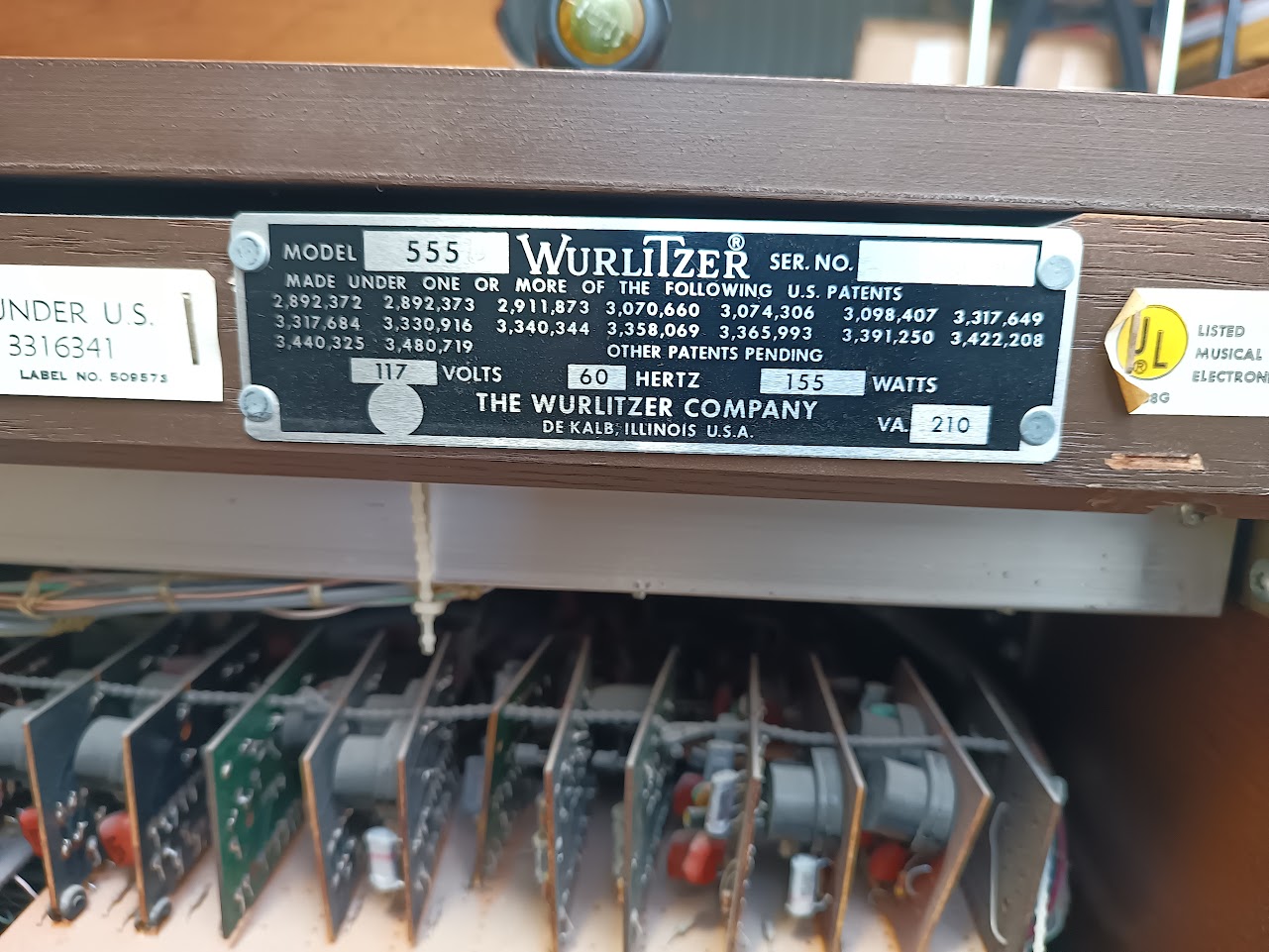 Rear nameplate. Serial number field present but unstamped. Photo: Ryan Malloy.
Architecture Summary
Section titled “Architecture Summary”The 555 uses a Top Octave Divider (TOD) architecture for its organ voices — a single master clock feeds a Top Octave Synthesizer IC, which is then divided down through flip-flop chains to generate all pitches across the keyboard range. This was the standard approach for consumer organs of the era, replacing the bulky individual-oscillator-per-note designs of earlier decades.
The Orbit III synthesizer is a separate monophonic VCO-based instrument bolted onto the console. It has its own oscillator, voicing, and amplifier chain — effectively a standalone analog synth that happens to share the same cabinet and speaker system.
The Rhythm Section is a third independent system — an analog pattern sequencer (Swingin’ Rhythm) with its own clock, percussion voice circuits, and auto-accompaniment features (Dancing Chords, Repeat). All three systems converge at the main mixing bus.
See Signal Architecture for the complete signal flow, Orbit III for the synthesizer, and Rhythm Section for the percussion and auto-accompaniment circuits.