Patents
The 555’s rear nameplate lists 17 US patents covering the organ’s circuit architecture, plus a separately licensed patent on an adjacent label. Three additional patents appear on the Leslie Tremolo Unit’s service label. The LSI chip patents from the existing research (below) postdate the nameplate but document the integrated versions of these same circuits.
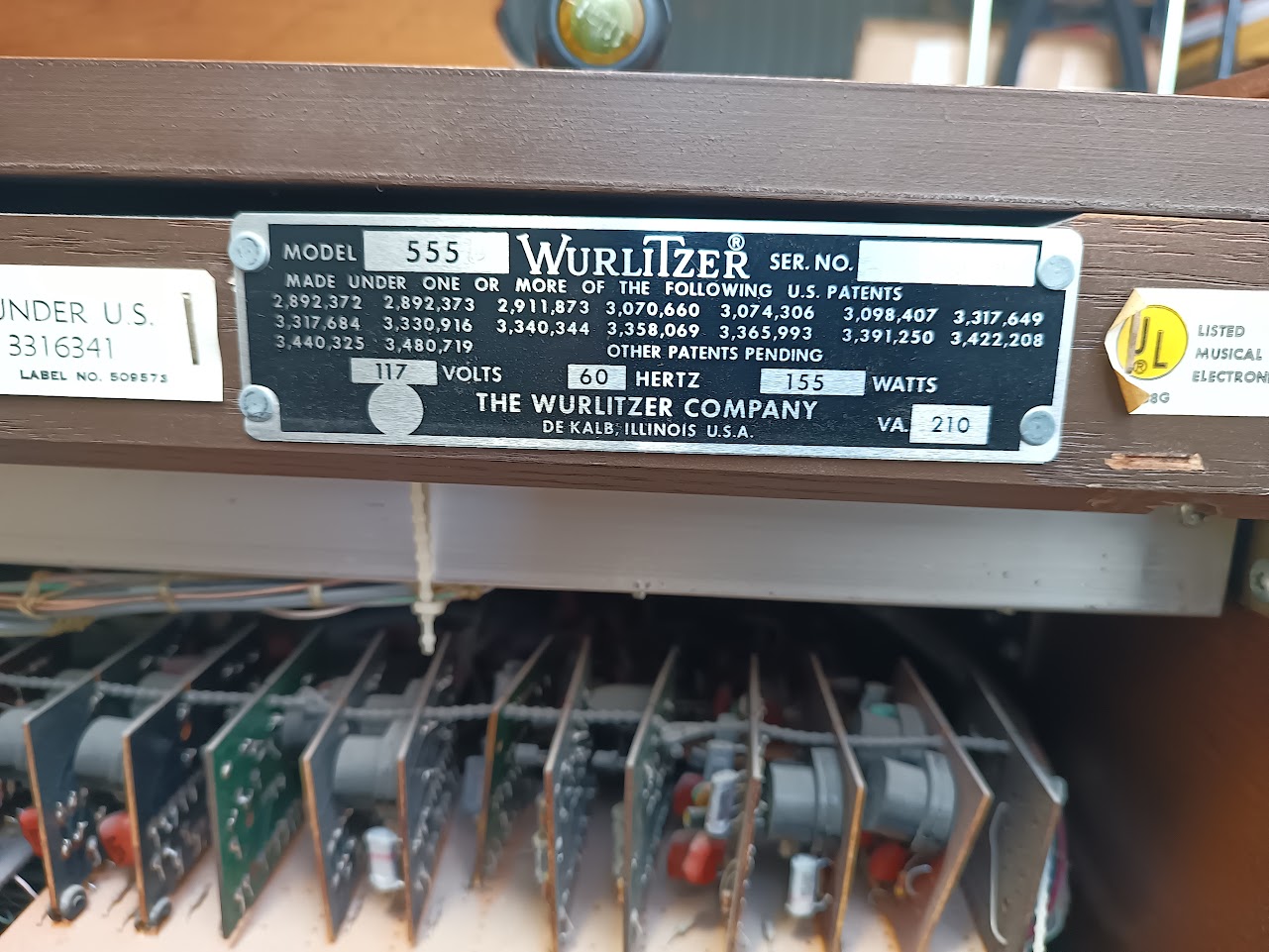 Rear nameplate listing 17 US patents. Photo: Ryan Malloy.
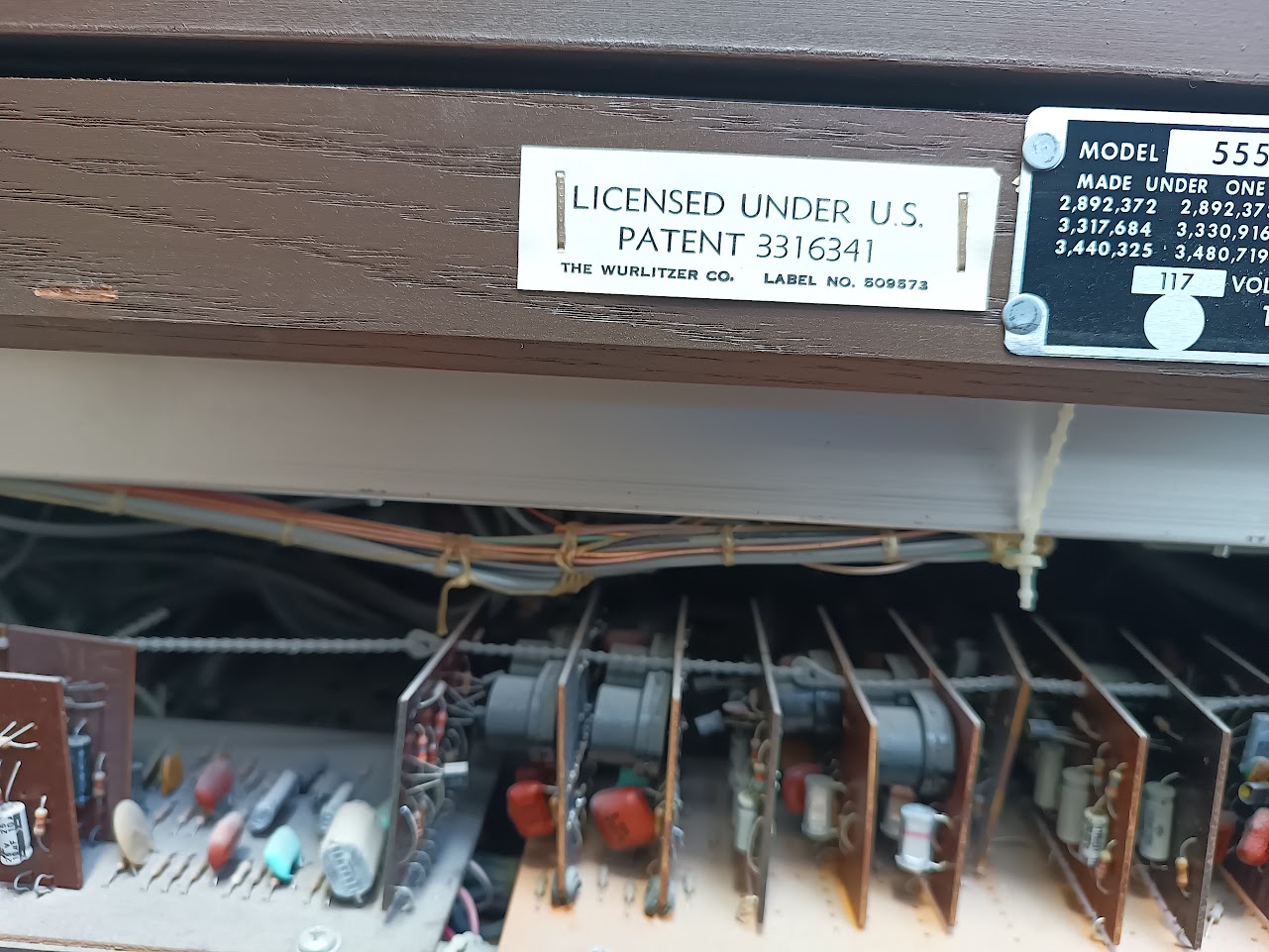 Separate license label for US Patent 3,316,341. Photo: Ryan Malloy.
Nameplate Patents
Section titled “Nameplate Patents”These 17 patents span 1959–1969 and document the discrete-component circuit designs that the 555 inherited or evolved from. Organized by function:
Tremolo and Vibrato
Section titled “Tremolo and Vibrato”| Patent | Title | Inventor(s) | Date | Description |
|---|---|---|---|---|
| US2892372 | Organ Tremulant | Howard G. Bauer | 1959 | All-electronic tremulant using phase shifting rather than volume modulation |
| US2892373 | Multiple Tremulant for Treble Tones | Howard G. Bauer | 1959 | Sequential phase-shifting for treble, volume modulation for bass |
Tone Generation and Voicing
Section titled “Tone Generation and Voicing”| Patent | Title | Inventor(s) | Date | Description |
|---|---|---|---|---|
| US3098407 | Tone Filters | John R. Brand, Joseph H. Hearne | 1963 | Half-octave filter grouping to produce flute, oboe, and trumpet voices from fewer filter stages |
| US3365993 | Post Signal Modulation in Electronic Musical Instruments | Harold O. Schwartz, Peter E. Maher | 1968 | Schmitt trigger + light-dependent resistor for percussive signal modulation after tone generation |
| US3440325 | Transistorized Hartley Oscillator Tone Generator Circuit | Harold O. Schwartz, William V. Machanian | 1969 | Voltage-detunable oscillator producing glissando and vibrato effects via base bias modulation |
Percussion and Rhythm
Section titled “Percussion and Rhythm”| Patent | Title | Inventor(s) | Date | Description |
|---|---|---|---|---|
| US3074306 | Percussion Arrangement for Electronic Musical Instrument | John H. Riggs, Frank B. Lumney, Howard G. Bauer | 1963 | Variable-load vacuum tubes for percussion effects on successive notes |
| US3317649 | Manual Control of Electronic Percussion Generator with Organ | Joseph H. Hearne | 1967 | Built-in rhythm accompaniment (bass drum, brush, cymbal) triggered by keyboard and pedal playing |
| US3340344 | Transistorized Electronic Percussion Generator with Organ | Harold O. Schwartz, Peter E. Maher | 1967 | All-transistor drum and cymbal synthesis integrated into the organ |
| US3358069 | Rhythm Device | Joseph H. Hearne | 1967 | Damped oscillators and noise generators synthesizing drum, cymbal, and wood block sounds |
Keying and Pedal Circuits
Section titled “Keying and Pedal Circuits”| Patent | Title | Inventor(s) | Date | Description |
|---|---|---|---|---|
| US3330916 | Bimetallic Contact Element for Electronic Musical Instrument | Howard G. Bauer | 1967 | Beryllium-copper wire + silver-platinum contact tip for key contacts — flexible yet arc-resistant |
| US3422208 | Electronic Latching Pedal | Robert D. Barry | 1969 | Neon bulb + diode switching for pedal sustain with automatic cancellation on new note |
| US3480719 | Electronic Organ Pedal Keying Circuit | Harold O. Schwartz, Robert D. Barry | 1969 | Solid-state pedal sustain with selectable duration and automatic cancellation |
Mechanical and Cabinet
Section titled “Mechanical and Cabinet”| Patent | Title | Inventor(s) | Date | Description |
|---|---|---|---|---|
| US2911873 | Organ Pedal Structure | Fred H. Osborne | 1959 | Compact pedal keyboard with resilient overload-yielding mount and low-friction guides |
| US3070660 | Rotary Electrical Apparatus | Anthony C. Ippolito | 1962 | Rotary transformer for spinning speaker (Spectratone predecessor) — ferrite core, silent operation |
| US3391250 | Reverberation Unit | George S. Klaiber, Anthony C. Ippolito | 1968 | Spring reverb with helical spring, electromagnetic transducers, and elastomeric dampers |
Stop Tablet and Controls
Section titled “Stop Tablet and Controls”| Patent | Title | Inventor(s) | Date | Description |
|---|---|---|---|---|
| US3317684 | Stop Tablet and Filter Assembly | Harold O. Schwartz, Howard M. Thomas | 1967 | Modular PCB-mounted stop tablets with integrated flexible switch contacts — no individual hand adjustment |
Separately Licensed Patent
Section titled “Separately Licensed Patent”Listed on a separate label adjacent to the nameplate:
| Patent | Title | Inventor(s) | Date | Assignee | Description |
|---|---|---|---|---|---|
| US3316341 | Electrical Musical Instruments | Richard H. Peterson | 1967 | Columbia Records Distribution Corp | Dynamic tone quality control via player-controlled filters and automatic envelope shaping |
This patent was not assigned to Wurlitzer — the “Licensed Under” language indicates Wurlitzer paid a royalty to use the technique. The original assignee (Columbia Records Distribution Corp) was part of the CBS family that also owned Electro Music / Leslie Speaker.
Leslie Tremolo Unit Patents
Section titled “Leslie Tremolo Unit Patents”Three patents listed on the Leslie unit’s service label, all assigned to CBS / Electro Music:
| Patent | Title | Inventor(s) | Date | Description |
|---|---|---|---|---|
| US3080786 | Speaker System for Adding Tremolo | Donald J. Leslie | 1963 | Separates harmonic-rich and harmonic-free channels, applies rotation primarily to cleaner tones |
| US3174579 | Acoustic Apparatus for Producing Tremolo and Vibrato | Donald J. Leslie | 1965 | Rotary horn with internal deflectors for broadened high-frequency radiation |
| US3315760 | Acoustic Damping Drive for Pulsato Rotor | Jacob M. Schwendener | 1967 | Rubber strap vibration isolation between drive pulley and polystyrene drum |
All three are by Donald J. Leslie or his colleagues at Electro Music. Leslie invented the rotating speaker concept in the 1940s; these patents cover the refined production versions used in the 555-era units.
LSI Chip Patents (1980–1981)
Section titled “LSI Chip Patents (1980–1981)”These postdate the nameplate but document the large-scale integration of the same circuit functions described in the discrete patents above. They cover the custom Wurlitzer ICs used in later production runs of the 555 and its contemporaries.
US4256002A — LSI Generator Chip for Electronic Organ
Section titled “US4256002A — LSI Generator Chip for Electronic Organ”Describes the divide-down architecture with detuning capability. This patent covers the fundamental tone generation approach used in the 555: a master oscillator feeding a top octave synthesizer, with divider chains producing all lower octaves. The detuning feature allows slight pitch offsets between voices for chorus effects.
patents.google.com/patent/US4256002
US4203337A — LSI Chip for Electronic Organ
Section titled “US4203337A — LSI Chip for Electronic Organ”Covers the LSI integration of organ functions — combining divider, keyer, and voicing circuits into fewer, larger ICs. This represents the evolution from discrete-component organs to the integrated approach used in the 555.
patents.google.com/patent/US4203337
US4253366A — LSI Chip for Electronic Organ
Section titled “US4253366A — LSI Chip for Electronic Organ”Additional LSI chip patent in the same family. Together, these three patents provide a comprehensive picture of Wurlitzer’s approach to integrating organ circuits into custom silicon during the mid-1970s.
patents.google.com/patent/US4253366
Relevance to the MIDI Conversion
Section titled “Relevance to the MIDI Conversion”Several of these patents directly inform the MIDI conversion project — from firmware timing constants to architectural decisions about how the ESP32 interprets pedal behavior.
Contact Metallurgy and Debounce Timing
Section titled “Contact Metallurgy and Debounce Timing”US3330916 (Bauer, 1967) describes the exact bimetallic contact used in the 555’s keys: a beryllium-copper wire for flexural strength paired with a silver-platinum tip for arc resistance and low contact oxidation. This isn’t academic — the contact bounce characteristics of that specific alloy combination determine the debounce timing in the shift register firmware. Beryllium-copper is springy and fast-recovering, which means shorter bounce duration than a typical phosphor-bronze contact. The patent’s description of the contact geometry also informs the CapSense feasibility work — it tells us the physical shape of the conductive element that the AC coupling approach would be sensing near.
Pedal Sustain — A MIDI Mapping Edge Case
Section titled “Pedal Sustain — A MIDI Mapping Edge Case”US3422208 and US3480719 (Barry and Schwartz, 1969) describe electronic latching pedal circuits that sustain a note after the pedal is released, automatically cancelling it when a new pedal is pressed. This means the pedal contacts don’t behave like simple switches — there’s active circuitry between the contact rail and the audio output that holds notes. The shift registers will see the raw contact state (pedal down / pedal up), but the organ’s audio output will lag behind on release because of the sustain circuit. The ESP32 firmware needs to account for this: either generate MIDI Note Off at the moment of physical release (letting the player’s DAW/synth handle its own sustain), or implement a sustain-aware mode that mirrors the organ’s own behavior. The former is simpler and more predictable; the latter preserves the organ’s voicing when playing through both speakers and MIDI simultaneously.
Rhythm Section Diagnostics
Section titled “Rhythm Section Diagnostics”Four patents (US3074306, US3317649, US3340344, US3358069) cover the evolution from vacuum-tube percussion effects to all-transistor rhythm synthesis. The 555’s untested rhythm section is the end product of this lineage. When testing resumes, these patents describe exactly how the drum, cymbal, and wood block circuits generate their sounds — damped oscillators and noise generators with specific envelope shapes. If any rhythm voice is dead, the patents give us the circuit topology to diagnose it without a service manual.
Leslie Signal Splitting
Section titled “Leslie Signal Splitting”US3080786 (Leslie, 1963) describes separating the organ’s output into harmonic-rich and harmonic-free channels before applying rotation — the rotation is applied primarily to the cleaner tones to minimize beat-frequency interference. This means the Leslie isn’t just spinning a single full-range signal; it’s doing frequency-dependent processing upstream of the motor. For the MIDI conversion, this matters if we ever want to tap the audio signal for analysis (e.g., using the organ’s own audio output as a secondary sensing mechanism). The signal at the Leslie input is already filtered and split.
The CBS Connection
Section titled “The CBS Connection”US3316341 (Peterson, 1967) was licensed from Columbia Records Distribution Corp — part of the same CBS family that owned Electro Music / Leslie Speaker. Wurlitzer was paying CBS for the dynamic tone quality control technique while simultaneously buying CBS’s Leslie units for the cabinet. The 555 has deeper ties to the CBS musical instrument empire than the speaker alone.
Spectratone to Leslie Transition
Section titled “Spectratone to Leslie Transition”US3070660 (Ippolito, 1962) describes a rotary transformer for a spinning speaker with ferrite cores and silent, maintenance-free operation — this is the Wurlitzer Spectratone that the Leslie replaced in later 555 production. The patent record now documents both sides of that transition: Wurlitzer’s own rotating speaker design (Ippolito, in-house) vs. the CBS/Leslie solution they eventually adopted. The 555 shipped with both configurations depending on production date; ours has the Leslie.
Why Patents Matter for Restoration
Section titled “Why Patents Matter for Restoration”Patent documents are often the most detailed public documentation of proprietary circuits. While service manuals show schematics at the board level, patents describe the internal logic of the custom ICs — useful when diagnosing failures or designing replacements.
The nameplate patents are particularly valuable because they predate the LSI integration. The discrete circuits they describe are the same functions that were later consolidated into the proprietary Wurlitzer ICs — understanding the discrete implementations helps reverse-engineer the ICs when service manuals are unavailable.
Key Inventors
Section titled “Key Inventors”Several names appear repeatedly across the patent portfolio:
| Inventor | Affiliation | Focus Areas |
|---|---|---|
| Howard G. Bauer | Wurlitzer (Corinth, MS) | Tremolo, contact design, percussion |
| Harold O. Schwartz | Wurlitzer | Percussion, keying, tone generation, stop tablets |
| Joseph H. Hearne | Wurlitzer | Tone filters, rhythm, percussion |
| Robert D. Barry | Wurlitzer | Pedal keying circuits |
| Anthony C. Ippolito | Wurlitzer | Rotary speaker, reverb |
| Donald J. Leslie | Electro Music / CBS | Rotating speaker systems |