Signal Architecture
Organ Section (Upper & Lower Manuals + Pedals)
Section titled “Organ Section (Upper & Lower Manuals + Pedals)”Architecture: Top Octave Divider (TOD) with Divider-Keyer ICs
A single master clock oscillator feeds a Top Octave Synthesizer (TOS) IC that generates all 12 chromatic notes of the highest octave. These are divided down through flip-flop chains to produce all lower octaves. By 1974, Wurlitzer used combined divider-keyer ICs (likely AMI S10430 or equivalent, 40-pin DIP) that handle both octave division AND key gating in one chip. Two S10430s per 44-note manual.
Signal Flow
Section titled “Signal Flow”graph TD
CLK[Master Clock<br/>Oscillator] --> TOS[Top Octave<br/>Synthesizer IC]
TOS --> N1["C8 · 4186 Hz"]
TOS --> N2["B7 · 3951 Hz"]
TOS --> N3["A#7 … C#8"]
TOS --> N4["C#8 · 4435 Hz"]
N1 --> DIV["÷2 Divider Chains<br/>C7 → C6 → C5 → C4 → C3 → C2"]
N2 --> DIV
N3 --> DIV
N4 --> DIV
DIV --> DK["Divider-Keyer ICs<br/>(AMI S10430 · 40-pin DIP)"]
DK --> KEY["Silver-Plated<br/>Key Contacts"]
KEY --> TAB["Tab Stop<br/>Filter Networks"]
TAB --> MIX[Mixing Bus]
MIX --> FX["Tremolo · Vibrato"]
FX --> REV[Reverb]
REV --> AMP[Amplifier]
AMP --> LSL["🔊 Leslie Speaker"]
AMP --> STN["🔊 Stationary Speakers"]
style CLK fill:#92400e,color:#fef3c7,stroke:#d97706
style TOS fill:#92400e,color:#fef3c7,stroke:#d97706
style AMP fill:#78350f,color:#fef3c7,stroke:#d97706
The factory divider schematic (Model 4037, February 1971) shows this architecture in full detail:
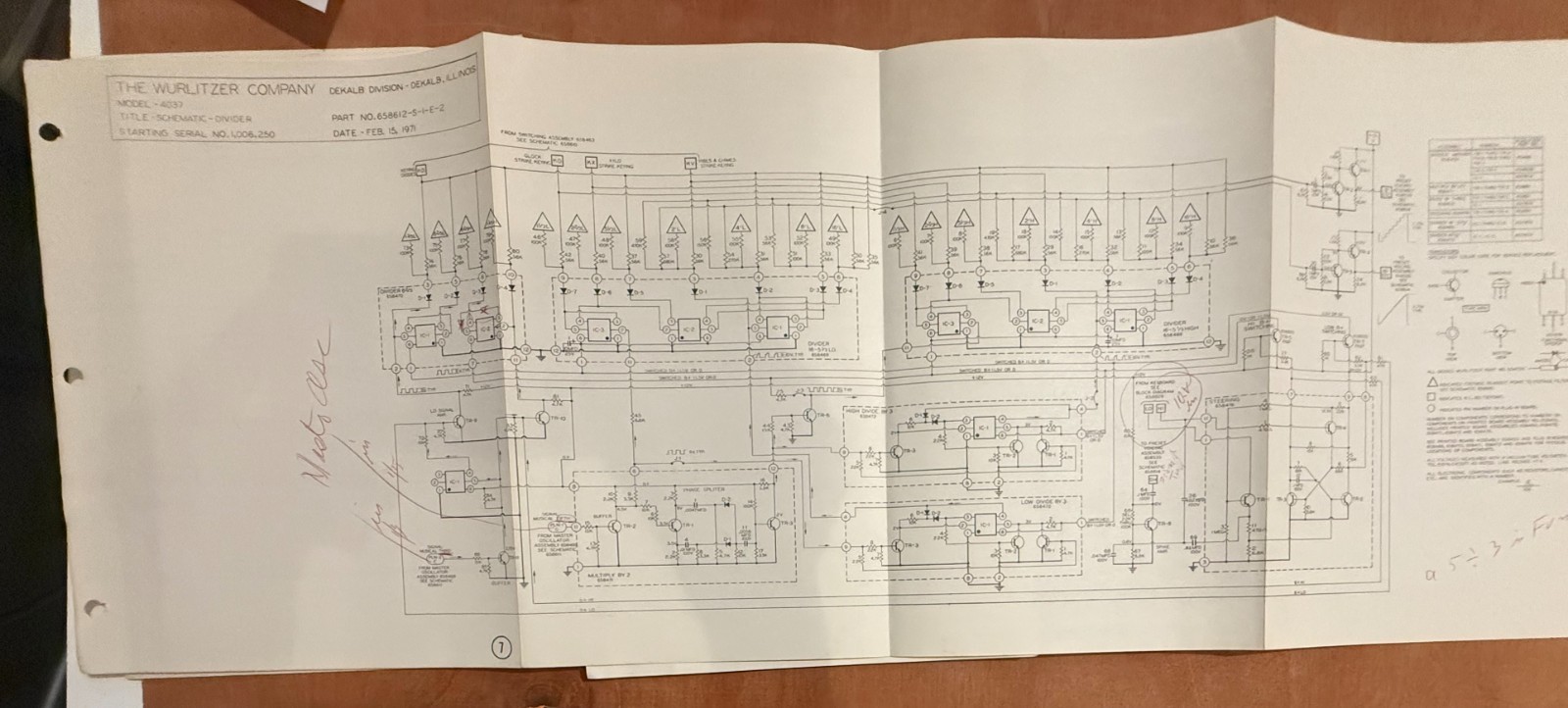 Factory divider schematic from the Orbit III service manual. “The Wurlitzer Company, DeKalb Division, DeKalb, Illinois.” Image: eBay listing preview.
Tab Stop Voicing
Section titled “Tab Stop Voicing”Footage numbers (16’, 8’, 4’) select which octave of the divider chain is routed to the output — a direct inheritance from pipe organ tradition where footage literally described the length of the pipe.
Voice names (Flute, Tibia, String, Diapason, Horn, Reed) select different passive filter networks that shape the square wave from the divider into approximations of those timbres.
Multiple tabs can be engaged simultaneously for registration building — layering voices to create composite timbres, exactly as a pipe organist pulls multiple stops.
Key Contact Detail
Section titled “Key Contact Detail”Each manual uses silver-plated SPST contacts. When a key is depressed, a silver-tipped plunger bridges two contact rails, connecting the corresponding divider output to the voice bus. The silver plating provides reliable low-resistance switching — these contacts are remarkably durable and rarely need replacement, though they can be cleaned by working the key plunger back and forth to scrape any oxidation.