Specifications
The Wurlitzer Custom Funmaker Model 555 is a dual-manual analog home organ manufactured circa 1974 by the Wurlitzer Company at their De Kalb Division in De Kalb, Illinois.
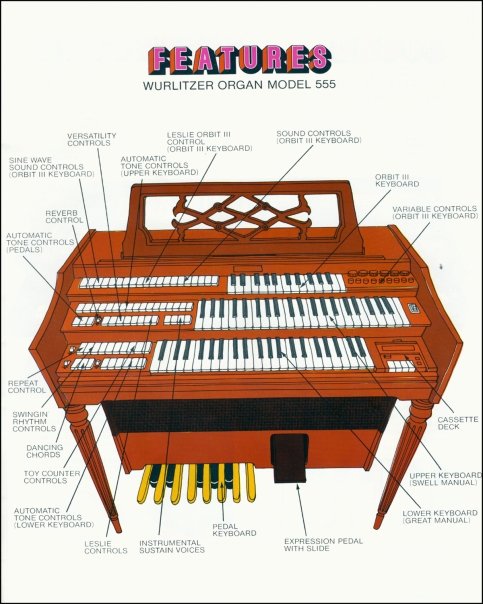 Console layout from the 1973 owner’s manual. Image: The Wurlitzer Company.
Specifications
Section titled “Specifications”| Spec | Detail |
|---|---|
| Model | Wurlitzer Custom Funmaker 555 |
| Year | ~1974 (copyright date on manual: 1973) |
| Manufacturer | The Wurlitzer Company, De Kalb Division, De Kalb, IL 60115 |
| Manual Part No. | 560609 / Form F 3407 |
| Upper Manual (Swell) | 44 keys, silver-plated contacts |
| Lower Manual (Great) | 44 keys, silver-plated contacts |
| Orbit III Synthesizer | 25 mini-keys (C-to-C), dual-contact (second touch aftertouch) |
| Pedalboard | 13 notes |
| Expression Pedal | Two-axis: vertical (volume swell) + lateral push-left (pitch slide/bend) |
| Speaker System | Leslie rotating speaker (post-1974; earlier models used Wurlitzer Spectratone) |
| Built-in Accessories | Cassette recorder/player, reverb |
| Connectors | Wurlitzer house-made (not AMP/Molex) |
Architecture Summary
Section titled “Architecture Summary”The 555 uses a Top Octave Divider (TOD) architecture for its organ voices — a single master clock feeds a Top Octave Synthesizer IC, which is then divided down through flip-flop chains to generate all pitches across the keyboard range. This was the standard approach for consumer organs of the era, replacing the bulky individual-oscillator-per-note designs of earlier decades.
The Orbit III synthesizer is a separate monophonic VCO-based instrument bolted onto the console. It has its own oscillator, voicing, and amplifier chain — effectively a standalone analog synth that happens to share the same cabinet and speaker system.
See Signal Architecture for the full signal flow, and Orbit III for the synthesizer details.