Orbit III Synthesizer
Overview
Section titled “Overview”The Orbit III is a self-contained monophonic analog synthesizer that swings up from the organ console for service. It has its own master oscillator (VCO), power supply, and amplifier. Introduced in 1971, it was bolted identically onto Wurlitzer models 4026, 4027, 4037, 4373, 4573, 460, 465, and 555.
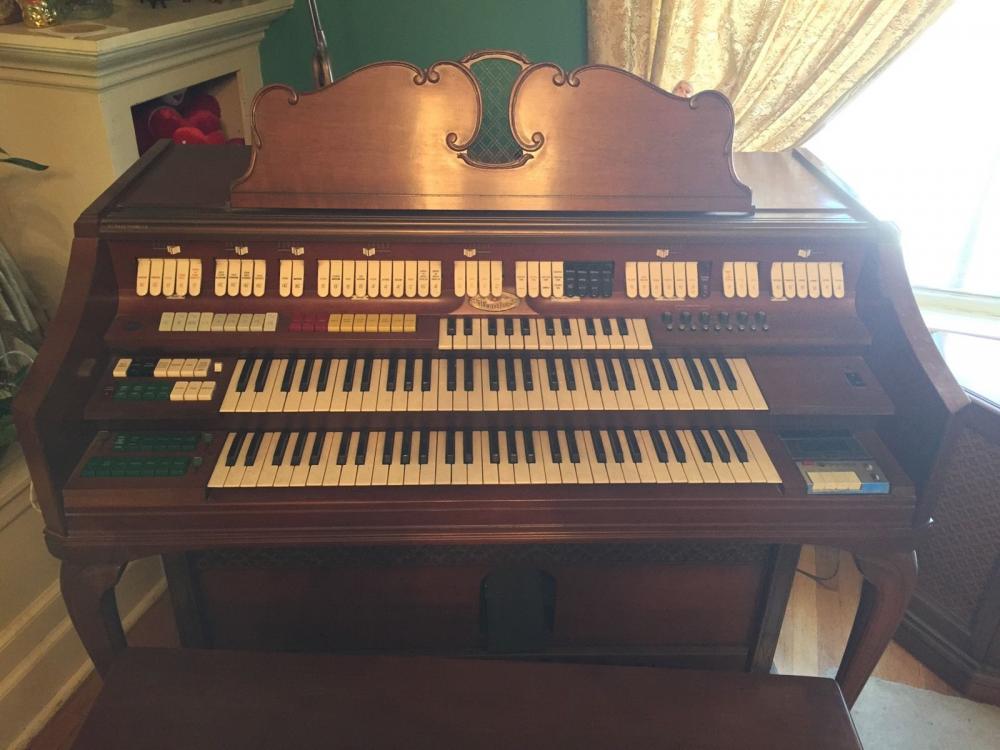 A Wurlitzer with Orbit III synthesizer. The Orbit III mini-keys sit above the upper manual with preset tabs to the left and variable controls to the right. Photo: synth-db.com.
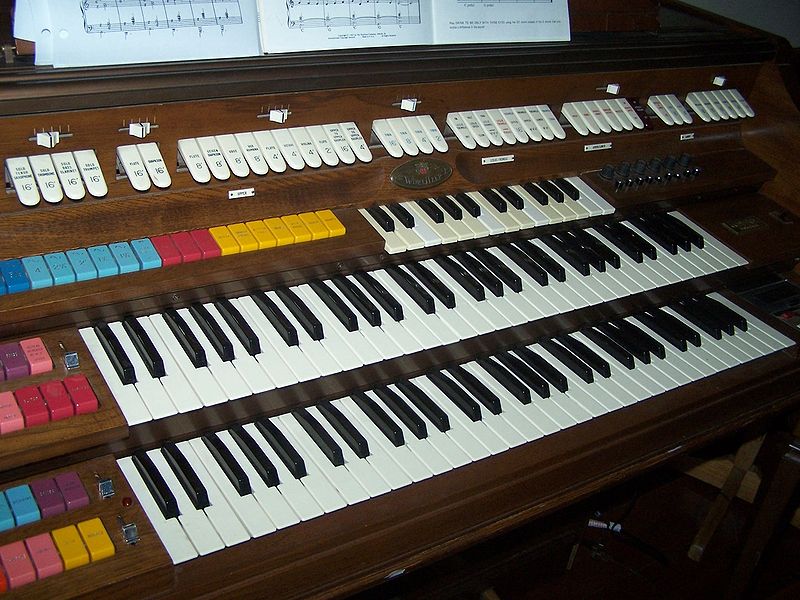 Close-up showing the 25-key Orbit III keyboard (top), colorful preset tabs, and the dual 44-key manuals below. Photo: synth-db.com.
Circuit Boards
Section titled “Circuit Boards”The Orbit III contains six main circuit boards, each handling a specific function:
| Board | Function |
|---|---|
| Master Oscillator (Issue 1 & 2) | VCO — the free-running voltage-controlled oscillator |
| Divider-Steering and Hi-Lo Gates | Octave dividers from VCO + note priority logic (highest/lowest note) |
| Xylo-Vibes-Glock and Chimes | Percussive preset voicing (attack/decay shaping) |
| Preset Voicing | Sustained voicings (Reed, Brass, String — filter networks) |
| Switching and Special Effects | Wah-Wah filter, LFO (Modulator), Second Touch, Slide, Delta Pitch |
| Amplifier and Power Supply | Dedicated amp and power rails for Orbit III |
Signal Flow
Section titled “Signal Flow”graph TD
KEYS["25 Mini-Keys<br/>(dual contact)"] --> LAD[Resistor Ladder<br/>Network]
LAD --> CV["Control Voltage"]
CV --> VCO["VCO<br/>(voltage-controlled oscillator)"]
VCO --> SINE["Sine Wave<br/>Tab Selection<br/>16' · 8' · 4' · 2' …"]
VCO --> PRESET["Preset Voicing<br/>Filters ×10"]
SINE --> WAH[Wah-Wah Filter]
PRESET --> WAH
WAH --> VCA["VCA<br/>Attack / Sustain"]
VCA --> LFO["LFO Injection<br/>(Modulator)"]
LFO --> DELTA["Delta Pitch<br/>(detune / chorus)"]
DELTA --> VOL[Volume]
VOL --> SPK["🔊 Leslie · Stationary"]
style KEYS fill:#92400e,color:#fef3c7,stroke:#d97706
style VCO fill:#92400e,color:#fef3c7,stroke:#d97706
style SPK fill:#78350f,color:#fef3c7,stroke:#d97706
Sine Wave Footage Tabs
Section titled “Sine Wave Footage Tabs”The footage tab labels come from pipe organ tradition — non-octave intervals that allow the player to build harmonic stacks from a single key press:
| Tab | Footage | Interval from 8’ unison |
|---|---|---|
| 16’ | Low | One octave below |
| 8’ | Unison | Concert pitch |
| 6-2/5’ | Major 3rd above 8’ | |
| 5-1/3’ | Perfect 5th above 8’ | |
| 4’ | One octave above | |
| 2-2/3’ | Octave + 5th | |
| 2’ | Two octaves above | |
| 1-3/5’ | Two octaves + major 3rd | |
| 1-1/3’ | Two octaves + 5th |
Preset Voicings
Section titled “Preset Voicings”Ten preset voice filters shape the VCO output:
Sustained: Reed, Brass, String, Banjo, Harpsichord, Electro Piano
Percussive: Vibes, Xylophone, Glock, Chimes
The percussive voices use attack/decay envelope shaping on the Xylo-Vibes-Glock board — the note decays naturally after key press, mimicking struck instruments.
Second Touch (Dual-Contact Aftertouch)
Section titled “Second Touch (Dual-Contact Aftertouch)”Each mini-key has two stacked switch contacts:
- Contact 1 (light press): Note ON — triggers VCO via CV ladder
- Contact 2 (deep press): Modulation — routes to LFO or Slide depending on button selection
This dual-contact system predates MIDI aftertouch by a decade. For the MIDI conversion, each Orbit III key contributes two digital inputs (50 total for 25 keys).